
They are both electronic manufacturing services (EMS) companies, also known as contract manufacturers. One is Taiwan's Foxconn group, the undisputed global number one in this business with revenues of $223 billion. The other is Dixon Technologies, the biggest domestic player with revenues of over Rs 10,500 crore.

Exports of electronics goods has risen by 24 per cent from April to November as compared with the same period in the last fiscal, the largest increase out of India's top 10 export categories. The increase has been propelled by mobile exports under the Production Linked Incentive (PLI) scheme and has pushed electronics up from sixth to fifth position in the top 10. A gap of $200 million separates electronics from occupying the fourth position, currently held by drugs and pharmaceuticals at $17.9 billion.

The new guidelines, effective from August 1, aim to expedite visa approvals for nationals from China and other countries sharing land borders with India.
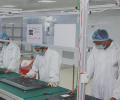
The stock of Dixon Technologies (India), the country's largest listed electronic manufacturing services (EMS) player, was up 6 per cent in 10 trading sessions, boosting the gains over the last three months to 21 per cent. The gains came following reports that Dixon will produce laptops in India in partnership with US and Chinese firms under the production-linked investment (PLI) scheme. It recently signed an agreement to make smartphones for Xiaomi India.
Dixon Technologies' January-March quarter (Q4) results came in well below expectations, but the potential for signing up a new mobile client, and plans for backward integration into display manufacturing kept investors happy. Dixon's Q4FY24 revenue grew 52 per cent year-on-year (Y-o-Y) to Rs 4,660 crore, below Street consensus, due to weakness in consumer electronics (Rs 890 crore) and home appliances (Rs 294 crore) segments.

In a major push towards 'Make in India', Apple Inc is manufacturing 70 per cent of the mobile phones, in value terms, that it sells in the domestic market, in India, according to sources aware of the development. This is a sharp rise from the figure of 30 per cent just two years ago and marks a major shift in Apple's strategy following the government's Production Linked Incentive (PLI) scheme that kicked off in FY'21. One of Apple's three vendors here, Foxconn, is currently manufacturing the best-selling model, the Apple 11, along with the Apple 10 and the Apple 12. Another contract manufacturer, Wistron, makes the Apple SE 2020. (The third, Pegatron, has yet to start production). The only models that are imported (they have limited volumes but high value) are the Apple 12 Pro and Pro Max.

'You have to be a total anti-national bozo to shut down the Nokia plant in Sriperumbudur, which was the first large manufacturing plant for mobile phones in India.' 'Why was the unit shut down? Because of somebody's ego.'

The government on Wednesday approved a Rs 7,350-crore scheme to boost production of laptops, tablets, all-in-one PCs and servers in the country, as it sought to woo global and domestic players to take advantage of India's manufacturing prowess. Production worth Rs 3.26 lakh crore and exports of Rs 2.45 lakh crore are estimated over the next four years under the new scheme, which is expected to create 1.80 lakh jobs. Briefing reporters after a meeting of the Cabinet, Communications and IT Minister Ravi Shankar Prasad said the Production Linked Incentive (PLI) scheme has been approved for IT hardware products that would cover laptops, tablets, all-in-one PCs and servers.

A Dubai trip plus Apple iPhone 12 is cheaper than buying the phone in India. Various models of the iPhone 12 Pro and Max are cheaper in Dubai by up to Rs 35,000 owing to higher GST, Customs duty in India.

But it may come with a downside risk of further rise in prices of several products.
Leading home-grown companies - Dixon Technologies (India), Amber Enterprises India, Tata Electronics, Chennai-based Munoth Industries, and Murugappa Group - along with global majors such as Japan's TDK Corporation, Taiwan's Hon Hai Technology Group (Foxconn), Austria's AT&S Austria Technologie & Systemtechnik AG (AT&S AG), and Japan's Murata Manufacturing Co, among others, have expressed initial interest in participating in the Rs 22,919 crore production-linked incentive (PLI) scheme cleared by the Union Cabinet, according to those privy to stakeholder discussions with the government.

The most striking features of this Budget was its focus on simplification and improving the ease of doing business in India, asserts Kaku Nakhate.

The government is expediting visa-related issues to bring technicians to India from any country, not just China, as and when required, to ensure the smooth implementation of the flagship production-linked incentive (PLI) scheme aimed at boosting domestic manufacturing. "If those under the PLI scheme need to get their equipment installed, we try to expedite the ability to get technicians into India from any country, whichever it may be," Union Commerce and Industry Minister Piyush Goyal told Business Standard in an interview.

Apple Inc's leading contract manufacturer, Taiwanese giant Wistron, has exceeded its investment obligation in India in just eight months, although the government's production-linked investment (PLI) scheme allowed it to complete the investment in four years. Between August 2020 and end March 2021, Wistron made an investment of Rs 1255 crore - 25 per cent more than the total investment it had committed to the government. Under the PLI scheme for mobile devices, the government had stipulated that each of the five participating global companies needed to invest Rs 250 crore every year for the first four years, totalling Rs 1,000 crore.

Apple is hoping to assemble in India 25 per cent of all iPhones produced globally to reduce its heavy dependence on China.

The Department for Promotion of Industry and Internal Trade (DPIIT) has proposed to raise the minimum local content under public procurement order in government contracts. But several local suppliers and multinational companies (MNCs) are saying such a steep target is not attainable. Class-I suppliers, whose goods, services or works offered for procurement has local content equal to or more than 50 per cent may see it hiked to 70 per cent, while it may go up to 50 per cent from 20 per cent for Class-II suppliers.
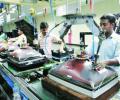
'The government expects demand for electronic products to reach $400 billion by 2023-24. This would be a huge foreign exchange outflow, which may further widen our trade deficit with other nations. Hence, the government plans to push local electronics manufacturing to cut down on their import bill.'

There's no change in Apple Inc's India strategy, said a top government source. 'It can only be enhanced'.

Apple's ambitious strategy to expand iPhone exports, shift more production from China to India at a faster pace, and grow its domestic market hits a Trump-sized roadblock.

Making the Pixel 8 in India will not necessarily bring the price down -- witness iPhones made in India that are more expensive than those in the US and Dubai.
The government is busy strategising ways to revive the domestic mobile device industry as Chinese firms have grabbed a large chunk of the handset market. The idea is to minimise competition from Chinese mobile players in the entry level or sub-Rs 10,000 category, according to a senior government official familiar with the plans. While discussions on the strategy are on, there's a growing consensus within the government that the lower end of the market should be reserved only for the domestic players, the official said.

In the last few years, zero per cent financing has become quite attractive as consumers aspire to buy the latest products, especially in categories such as mobile phones and television sets.

Highlights of the Union Budget 2024-25 presented by Finance Minister Nirmala Sitharaman in Lok Sabha on Tuesday.
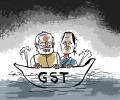
Experts said the rate hike would improve working capital position of the manufactures as it would correct the inverted duty structure but may lead to increase in price of the finished goods.

In the run-up to Apple CEO Tim Cook's visit to India, government officials are finalising the talk points with the Cupertino-headquartered tech major. Officials said that the government would like Apple to "deepen" the company's engagement in the manufacturing and assembly of iPhones in the country and not limit itself only to the minimum commitments made under the production-linked incentive (PLI) scheme for mobile devices. The conversations between the two sides are likely to focus on that.

The Union Budget on Wednesday outlined several initiatives to drive India's technology agenda and boost digital infrastructure, including new centres of excellence for artificial intelligence, National Data Governance Policy, and Entity DigiLocker.

How dominant are Chinese firms in India's sub-Rs 10,000 mobile device market? The question has become relevant as the government has been thinking of reserving this price segment for domestic players who have not been able to battle the Chinese onslaught. However, telecom firms and others are concerned that such a move could stymie the effort to build affordable 5G phones in the sub-Rs 10,000 category.

The government's target of hitting $52 billion to $58 billion in mobile phone exports in FY26 has been faltering; an Indian corporate group with financial muscle will help.

Union Finance Minister Nirmala Sitharaman on Tuesday commended Indian financial sector regulators for doing a "world-class job" and bringing greater transparency into the system. Underlining that she is not against questioning or critiquing regulators, Sitharaman said there is a need to be "extremely conscious" about contributions made by them as well. Speaking at the Financial Express Best Banks Awards, the finance minister said, "I strongly recommend that facts are taken on board before we discuss anything to do with the regulators, strictly speaking."

Prime Minister Narendra Modi on Friday said production linked incentive (PLI) scheme, which is aimed at boosting domestic manufacturing and exports, is expected to increase the country's production by $520 billion in the next five years. Addressing a webinar on PLI scheme, organised by Department of Industry and International Trade (DPIIT) and NITI Aayog, through video conference, Modi said the government is continuously carrying out reforms to boost domestic manufacturing. In this year's Budget, about Rs 2 lakh crore was earmarked for the PLI scheme for the next five years and "there is an expectation that the scheme would result in increasing the production by about $520 billion in the next five years", he said. He added that there is also an expectation that the current workforce in the sectors, which will avail the benefits of the PLI scheme, will be doubled and job creation will also increase.

The onslaught of Chinese mobile brands is virtually obliterating Indian brands, especially in terms of value. According to industry estimates based on excise and Custom duty trends, the value share of Indian brands (across smartphones and feature phones, operator phone sales - which is mostly Jio phones - and the value of phones smuggled into the country) has dropped to a mere 1.2 per cent in January-October 2021 compared to 25.4 per cent in the calendar year 2015. In the same period, the Chinese have established their domination, hitting a value share of 64.5 per cent, up from 17.8 per cent.

Apple and Samsung are international players and should work as a team with domestic companies to transform India into a global powerhouse: IT Minister Ravi Shankar Prasad.

The PM gave a call for 'Sabka Prayas' (everyone's efforts) along with ''Sabka Saath, Sabka Vikas, Sabka Vishwas'' for building a self-reliant India.

Prime Minister Narendra Modi on Saturday inaugurated the 6th India Mobile Congress at Pragati Maidan in Delhi and launched 5G services. The 5G telecom services seek to provide seamless coverage, high data rate, low latency and highly reliable communications system. The three major telecom operators of the country demonstrated one use case each in front of the prime minister to show the potential of 5G technology in India.

Tata Electronics' Rs 91,000 crore semiconductor fab in Dholera, Gujarat, in partnership with PSMC, will generate over 20,000 direct and indirect skilled jobs in the region and construction of the mega unit is expected to begin this year, according to a statement on Thursday. The planned unit - India's first commercial fab, marks Tata Electronics' entry into the global semiconductor industry. Tata Electronics said it is "proud to lead India's entry into global semiconductor fabrication".

'India needs many more job creators, both in manufacturing and services, to make it big.' 'For that, the red carpet must be rolled out fully and for all investors without holding back,' suggests Nivedita Mookerji.

The government on Thursday imposed import restrictions on laptops, tablets, all-in-one personal computers, ultra small form factor computers, and servers with immediate effect. The Directorate General of Foreign Trade (DGFT) in a notification said exemption from import licensing is provided up to 20 items per consignment for R&D, testing, benchmarking and evaluation, repair and return and product development purposes.

The new mantra was to align Apple's ambition with the government's, focusing on Modi's favourite themes of Make in India, employment generation and India as a high-tech export hub.

The government has asked industry to provide a list of Chinese suppliers that would like to shift some capacity to India provided they are willing to set up JVs with Indian companies.

While the tax holiday for the factory coming to an end might be a factor, many say the business model of Microsoft (which acquired Nokia's handset division last year), as well as freebies offered by the Vietnamese government, might also have played a role.
